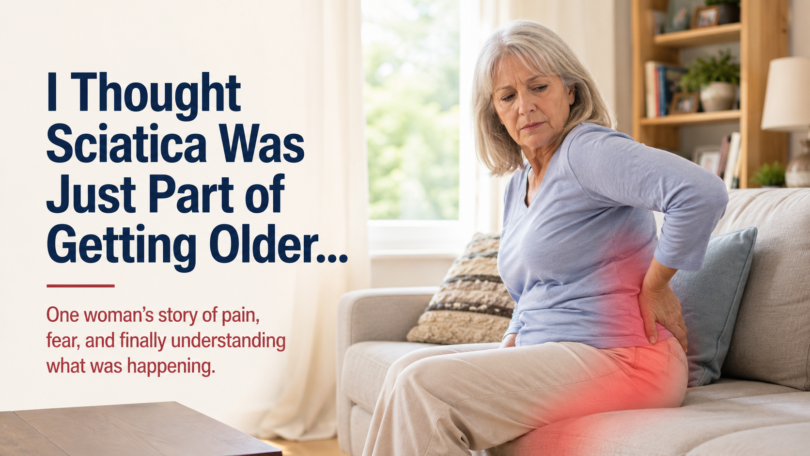
My name is Margaret, and I’m 68 years old.
For a long time, I thought what I was feeling was just part of getting older.
At my age, you expect a few aches.
ADVERTISEMENT
A stiff back in the morning.
A sore hip after walking too much.
A little discomfort after sitting for a long time.
But this was different.
This pain started deep in my lower back, then moved into my hip. Some days, it traveled down the back of my leg like a hot wire. Other days, it felt like burning, tingling, numbness, or pins and needles in my calf and foot.
At first, I ignored it.
Then I rested.
Then I stretched.
Then I tried pain relief creams, hot baths, pillows, over-the-counter painkillers, and every “quick sciatica exercise” I could find online.
But no matter what I tried, the pain kept coming back.
And little by little, it started taking pieces of my life from me.
The Pain Was Bad… But the Fear Was Worse
I used to enjoy simple things.
Walking through the grocery store.
Cooking dinner without leaning on the counter.
Sitting through church without shifting every few minutes.
Playing with my grandchildren.
Sleeping through the night.
But sciatica changed the way I lived.
I started planning everything around pain.
Before leaving the house, I would ask myself:
“Will there be somewhere to sit?”
Then I would immediately think:
“What if sitting makes it worse?”
Long car rides became stressful.
Dinner with family became uncomfortable.
Even watching TV became difficult because sitting on the couch could send pain shooting down my leg.
Some nights, I would wake up around 2:47 AM with burning pain running from my lower back into my hip and thigh.
I would turn to one side.
Then the other.
Pillow between my knees.
Pillow under my knees.
Heat pack.
Cold pack.
Nothing felt right for long.
And eventually, I started asking myself the question I was afraid to say out loud:
“Is this my life now?”
Everyone Gave Me the Same Advice
When I first talked about my pain, the advice sounded simple.
“Just rest.”
“Take something for the pain.”
“Try stretching.”
“It happens when you get older.”
But nobody explained why the pain traveled down my leg.
Nobody explained why sitting made it worse.
Nobody explained why some stretches seemed to help one day and make everything worse the next.
Nobody explained the difference between normal lower back pain, sciatic nerve pain, herniated disc pain, spinal stenosis symptoms, and nerve pain in the leg.
So I kept guessing.
And that was the problem.
I was treating the pain like it was just a sore muscle.
But what I was feeling did not behave like a normal sore muscle.
It burned.
It shot down my leg.
It tingled.
It moved.
Sometimes it made my leg feel strange, weak, or unreliable.
That scared me.
I Tried to Fix It the Way Most People Do
Like many people, I went online and searched for sciatica pain relief.
I found endless advice.
Some people said to stretch my hamstrings.
Some said to stretch my piriformis.
Some said to bend forward.
Some said to bend backward.
Some said to try yoga.
Some said never do yoga.
The more I searched, the more confused I became.
So I tried a little bit of everything.
But sometimes, after stretching, the pain down my leg felt sharper.
That was when I started realizing something:
Maybe I didn’t just need more tips.
Maybe I needed a better understanding of what was actually happening.
I started reading more about physical therapy for sciatica, sciatica exercises, MRI scans, herniated disc treatment, spinal stenosis treatment, pain management doctors, chiropractors, orthopedic spine specialists, and lower back pain treatment options.
For the first time, I realized there were different reasons someone could have sciatica-like pain.
And if the reason is different, the approach may need to be different too.
That made sense to me.
Because what helped one person online did not always help me.
Sometimes it made me worse.
Sitting Became My Enemy
One of the strangest parts was how much sitting affected me.
Walking slowly sometimes felt okay.
Lying down sometimes helped.
But sitting?
Sitting could ruin my whole day.
A soft couch made it worse.
A long car ride made it worse.
A restaurant chair made it worse.
Even sitting at the kitchen table could send pain into my hip and leg.
I started avoiding places where I knew I would have to sit for too long.
Family dinners.
Church events.
Long drives.
Waiting rooms.
I hated that.
I did not want to become the person who always said no.
I did not want my grandchildren to remember me as the grandmother who was always in pain.
So I began paying attention to what triggered it.
I started taking short walking breaks.
I changed the way I sat.
I looked into lumbar support.
I became more careful with soft couches.
I started thinking about things I had never cared about before, like ergonomic chairs for back pain, better posture while driving, and finding a supportive mattress for sciatica.
It wasn’t about buying one magic product.
It was about finally noticing the patterns.
I Realized Pain Relief Was Not Always the Same as Getting Better
At first, all I wanted was relief.
When your leg is burning, you don’t think about long-term health.
You just think:
“How do I make this stop?”
So I kept chasing temporary comfort.
A hot bath.
A cold pack.
A painkiller.
A pillow.
A stretch.
Sometimes something helped for a little while.
But then the pain came back.
That was one of the hardest parts emotionally.
Because every time I felt a little better, I thought maybe it was finally over.
Then one wrong movement, one long sit, or one bad night of sleep would bring it back again.
I started to understand that covering the pain for a few hours was not the same as understanding why it kept returning.
I needed to stop treating every flare-up like a random accident.
I needed to pay attention.
I needed better questions.
And I needed to stop blaming myself.
My Breaking Point Came at a Family Birthday
The moment I finally took it seriously happened after a family birthday.
I had been excited all week.
My daughter made dinner.
My grandchildren were there.
Everyone was laughing.
For a little while, I felt like myself again.
Then, after about 20 minutes of sitting, I felt the familiar burning start in my lower back.
It moved into my buttock.
Then down my leg.
I smiled through it.
But inside, I was counting the minutes until I could stand up.
I didn’t want to ruin the evening.
I didn’t want everyone worrying about me.
So I pretended I was fine.
But that night, I cried in the bathroom.
Not only because of the pain.
I cried because I felt like my body was quietly taking my independence from me.
I felt embarrassed.
I felt frustrated.
I felt old.
And I hated feeling that way.
The next morning, I made a decision.
I was going to stop treating my sciatica like “just one of those things.”
I was going to understand it better.
I Started Asking Better Questions
Instead of searching for another random stretch, I started asking better questions.
Was my pain truly sciatica?
What could be irritating the nerve?
Could this be related to a herniated disc?
Could it be spinal stenosis?
Would physical therapy for sciatica help me?
Should I speak with a chiropractor, pain management doctor, or orthopedic spine specialist?
When does someone need an MRI scan for sciatica?
What symptoms should never be ignored?
Could my health insurance cover physical therapy?
What daily habits were making the pain worse?
Which movements should I avoid?
How could I get back to walking, sleeping, and living normally without constantly being afraid of the next flare-up?
Those questions changed the way I looked at my pain.
For the first time, I felt less helpless.
I still had pain.
I still had bad days.
But I was no longer blindly guessing.
The Part That Scared Me Most
The scariest part of sciatica was not only the pain.
It was the thought of losing mobility.
I started imagining what could happen if I kept ignoring it.
What if walking became harder?
What if I could not travel?
What if I could not play with my grandchildren?
What if I started needing help for things I used to do by myself?
I know not every case becomes serious.
But I also know that certain symptoms should not be ignored.
If someone has sudden leg weakness, foot drop, loss of bladder or bowel control, numbness around the groin area, severe pain after a fall or car accident, or symptoms that keep getting worse, they should not rely on home remedies.
They should get medical help.
Learning that made me take my symptoms more seriously.
Not with panic.
But with respect.
My body was trying to tell me something.
And for too long, I had been trying to silence it instead of understand it.
What I Wish I Had Understood Earlier
Looking back, I wish I had understood that sciatica is not always just normal aging.
I wish I had known that pain traveling down the leg can involve the nerve.
I wish I had known that random stretching is not always the answer.
I wish I had paid attention sooner to how sitting, sleeping, posture, and daily habits affected my pain.
I wish I had understood that different people may need different approaches.
Some people may improve with physical therapy and movement changes.
Some may need help from a chiropractor or doctor.
Some may need an MRI scan.
Some may discuss epidural steroid injections with a pain management doctor.
Some serious cases may require back surgery.
And if the pain started after a car accident or work injury, some people may need documentation for workers’ compensation, health insurance, or medical claims.
I am not saying everyone needs the same treatment.
I am saying people deserve better information before they spend months guessing.
Why I’m Sharing This
I’m sharing this because I know what it feels like to be scared in silence.
I know what it feels like to smile through dinner while your leg is burning.
I know what it feels like to wake up in the middle of the night and wonder if the pain will ever stop.
I know what it feels like to search online for answers and become more confused than when you started.
And I know what it feels like to be told:
“It’s just age.”
But I don’t believe pain should be dismissed just because someone is older.
I don’t believe we should have to lose sleep, confidence, mobility, and independence without at least understanding what may be happening.
I don’t believe in miracle claims.
But I do believe in learning enough to ask the right questions.
A Simple Resource That Helped Me Understand More
If you are dealing with sciatica pain, lower back pain, hip pain, or nerve pain running down your leg, the most important first step is education.
Before trying another random stretch or ignoring the pain again, it may help to understand what could be triggering your symptoms and what options may be available.
That is why I recommend checking out this sciatica information resource here:
Click here to learn more about this sciatica resource
It may help you better understand sciatica, pain relief options, and the next questions to ask.
This is not a replacement for medical care. If your symptoms are severe, worsening, or include numbness, weakness, or bladder/bowel changes, speak with a healthcare professional urgently.
Final Word
I did not wake up one day with all the answers.
I simply stopped accepting vague advice.
I stopped blaming myself.
I stopped treating sciatica like “just old age.”
And I started learning what my body may have been trying to tell me.
If you are over 65 and dealing with sciatica, maybe this is your reminder too.
Do not panic.
Do not chase miracle claims.
Do not ignore serious symptoms.
And do not assume your pain is meaningless just because it is common.
Your life still matters.
Your sleep still matters.
Your mobility still matters.
Your independence still matters.
Start by learning what may be happening.
Then take the next right step.